Perceptual Switch for Gaze Selection (UIST ’18 Adjunct)
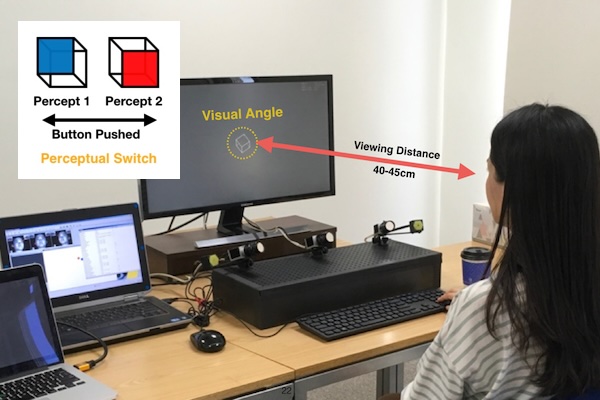
In Perceptual Switch for Gaze Selection, published in the UIST ’18 Adjunct proceedings, we explored bistable perception as a mechanism for intentional input. Traditional fixation-based gaze interfaces struggle to distinguish purposeful selection from casual looking, leading to the well-known “Midas touch” problem.
We introduced a Necker cube UI element and hypothesized that voluntarily switching between its rivaling interpretations would elicit distinctive oculomotor patterns that can serve as a robust selection signal. Eye-tracking data from user studies showed that voluntary perceptual switches do indeed produce characteristic gaze dynamics that are separable from passive viewing.
This work demonstrated that cognitive phenomena such as perceptual bistability can be harnessed as input channels and trained me to use noisy, high-dimensional eye-movement data as structured evidence about internal decision processes.